Compare Bulldozer Types by Undercarriage
bulldozer types describe more than a machine’s size. A buyer should compare undercarriage, blade, ground conditions, pushing distance, and available service support before treating two quotations as equivalent.
Start a bulldozer types comparison with the work: clearing, spreading fill, trimming a grade, or pushing loose material. Record the site slope, soil moisture, obstacles, and required finish.
Match the Blade to Material
Tracked bulldozer types spread machine weight across a relatively large contact area. They commonly suit rough or soft ground, but track condition, ground pressure, and turning impacts still require model-specific review.
Wheeled bulldozer types can travel more readily across suitable firm surfaces. Their traction and tire protection depend on the ground and task; never infer that a wheeled machine will replace a crawler everywhere.
Within tracked bulldozer types, compare standard and lower-ground-pressure arrangements only where the supplier lists both. A wider track may help on some soft ground while changing transport width and undercarriage wear.
The best bulldozer types shortlist also considers site access. Measure gates, overhead clearance, trailer limits, and the room needed to turn at the end of each push before requesting a price.
Do not compare bulldozer types only by advertised horsepower. Blade capacity, traction, ground condition, travel distance, and operator technique affect useful output; ask for the full specification and intended setup.
| Decision point | Evidence to request |
|---|---|
| Ground | Track or tire suitability |
| Pushing | Blade shape and distance |
| Access | Machine and transport dimensions |
Bulldozer Types in the LICH Catalogue
Straight blades are one of the practical bulldozer types distinctions. A straight blade is often selected for grading and shorter pushes; confirm its actual dimensions and adjustable movements on the quoted machine.
Universal blades are another bulldozer types option, with a curved profile intended to retain more loose material. Blade volume is model specific, and a large blade can be a poor match for precise finishing.
Semi-universal and angle blades expand the bulldozer types discussion. Angle control can move material to one side, while blade geometry changes how it carries material; request the attachment drawing rather than guessing.
For bulldozer types that include a rear ripper, identify the material to be loosened and the expected working depth. Ripping capability depends on machine and tool configuration, not the rear mounting alone.
Check the Complete Configuration
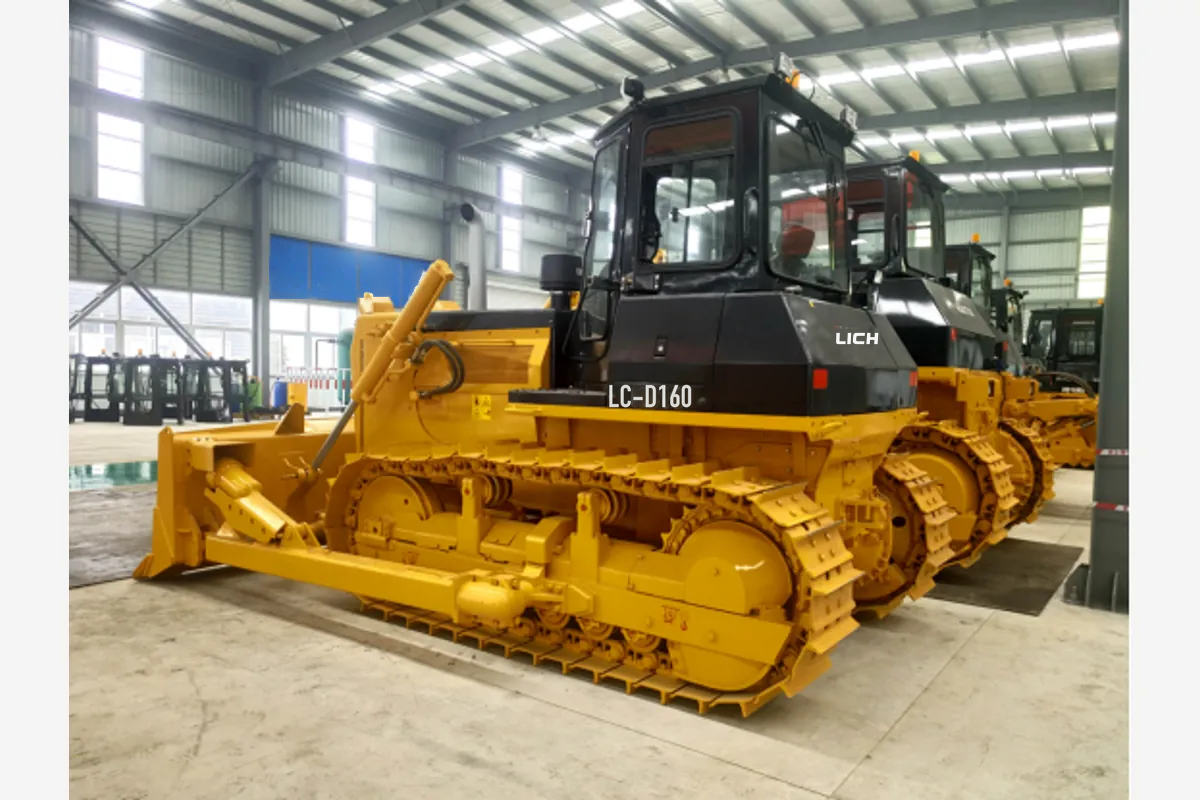
The LICH LC-D160 listing is a crawler example for a bulldozer types shortlist. Its published description names roads, mines, and earthwork; written quotation should identify the actual blade and options.
A catalogue photo cannot prove every bulldozer types configuration. Review the quoted unit’s serial identity, track shoes, blade mount, hydraulic controls, and any ripper separately before accepting an equipment list.
When evaluating bulldozer types for haul-road work, request the desired finish tolerance, material type, and push direction. A motor grader may be needed for final shaping even when a dozer handles bulk earthmoving.
For land clearing, bulldozer types selection should also account for debris handling and protection packages. Confirm guards and approved tools by model; do not infer that every photograph shows standard equipment.
Build a Useful Inquiry
Ask each seller of bulldozer types to itemize base machine, blade, optional ripper, cab, track arrangement, transport preparation, and spare parts. That gives purchasing teams a comparable commercial scope.
Send a short video or site plan with the bulldozer types inquiry. Mark access points, stockpile locations, push distances, and loading areas so the proposed machine can be reviewed against the real workflow.
For international bulldozer types orders, confirm packing dimensions, shipping mass, destination, and unloading responsibility in writing. Operating weight does not automatically equal the packed transport weight.
Plan maintenance while comparing bulldozer types: request applicable manuals, filter identification, undercarriage wear parts, and service intervals. Support commitments, local stock, and warranty terms require written confirmation.
Practical buyer worksheet
Create a one-page comparison with columns for terrain, material, push distance, finish tolerance, site access, and available transport. Ask each supplier to identify the proposed blade, track or tire arrangement, rear tools, and any excluded options against the same sheet. Record the source and date of each dimension. For a sloped site, include a plan showing approach direction and turning space. For wet ground, request the maker’s undercarriage details rather than a generic claim about flotation. Share the sheet with the operator before purchase; a practical review can reveal missing access, visibility, or material-handling requirements that a sales photograph cannot show. Keep photographs and written answers together for future checks.
Bulldozer Types: Buyer Questions
Are larger bulldozer types always more productive? No. A larger machine may face access, transport, or finishing constraints. Compare estimated cycle work under the same site assumptions and blade configuration.
Can one blade serve all bulldozer types tasks? Sometimes, but material retention and grading control differ. Ask which blade is included and whether the proposed alternative is available for the exact model.
To compare bulldozer types quotes, send LICH the task, terrain, proposed push length, blade requirement, quantity, and destination through the contact form; verify the final setup before ordering.