A mini road roller is a compaction machine under about 3.5 t that fits where a full-size roller cannot turn: footpaths, driveways, trench lines, patch repairs and the edges of a road. LICH lists nine of them, from a 330 kg walk-behind unit with one 600 mm drum to a 3,300 kg ride-on tandem with 1,250 mm drums. This guide puts all nine in one table, then works out two figures the catalogue does not print: how hard each mini road roller presses per centimetre of drum, and how much of its compaction comes from vibration.
All nine models are in the road roller range, and the two-drum machines are also listed under tandem rollers.
Mini road roller models and specifications
| Model | Type | Operating weight | Drum width | Engine power | Vibration force | Travel speed | Gradeability |
|---|---|---|---|---|---|---|---|
| LC600 single drum | Walk-behind | 330 kg | 600 mm | 4 kW | 15 kN | 0–4 km/h | 30% |
| LC600 tandem | Walk-behind | 560 kg | 600 mm × 2 | 4 / 5.67 kW | 18 kN | 0–4 km/h | 30% |
| LC700Z | Ride-on tandem | 800 kg | 700 mm front, 500 mm rear | 4 / 5.67 kW | 20 kN | 0–5 km/h | 30% |
| LC800 | Ride-on tandem | 1,200 kg | 800 mm × 2 | 5.9 / 8.8 kW | 25 kN | 0–6 km/h | 30% |
| LC900 | Hydraulic tandem | 1,500 kg | 900 mm × 2 | 8.8 kW | 30 kN | 0–6 km/h | 35% |
| LC1000 | Hydraulic tandem | 2,000 kg | 1,000 mm × 2 | 11.5 kW | 30 kN | 0–6 km/h | 35% |
| LC1100 | Hydraulic tandem | 2,500 kg | 1,100 mm × 2 | 28.5 kW | 45 kN | 0–9 km/h | 30% |
| LC1200 | Hydraulic tandem | 3,000 kg | 1,200 mm × 2 | 28.5 kW | 45 kN | 0–8 km/h | 30% |
| LC203 | Hydraulic double drum | 3,300 kg | 1,250 mm × 2 | 26.5 kW | 2 × 30 kN | 0–12 km/h | 30% |
Source: LICH product catalogue, read on 13 November 2026. The eight smaller machines vibrate at 70 Hz and the LC203 at 50 Hz.
Three kinds of mini road roller
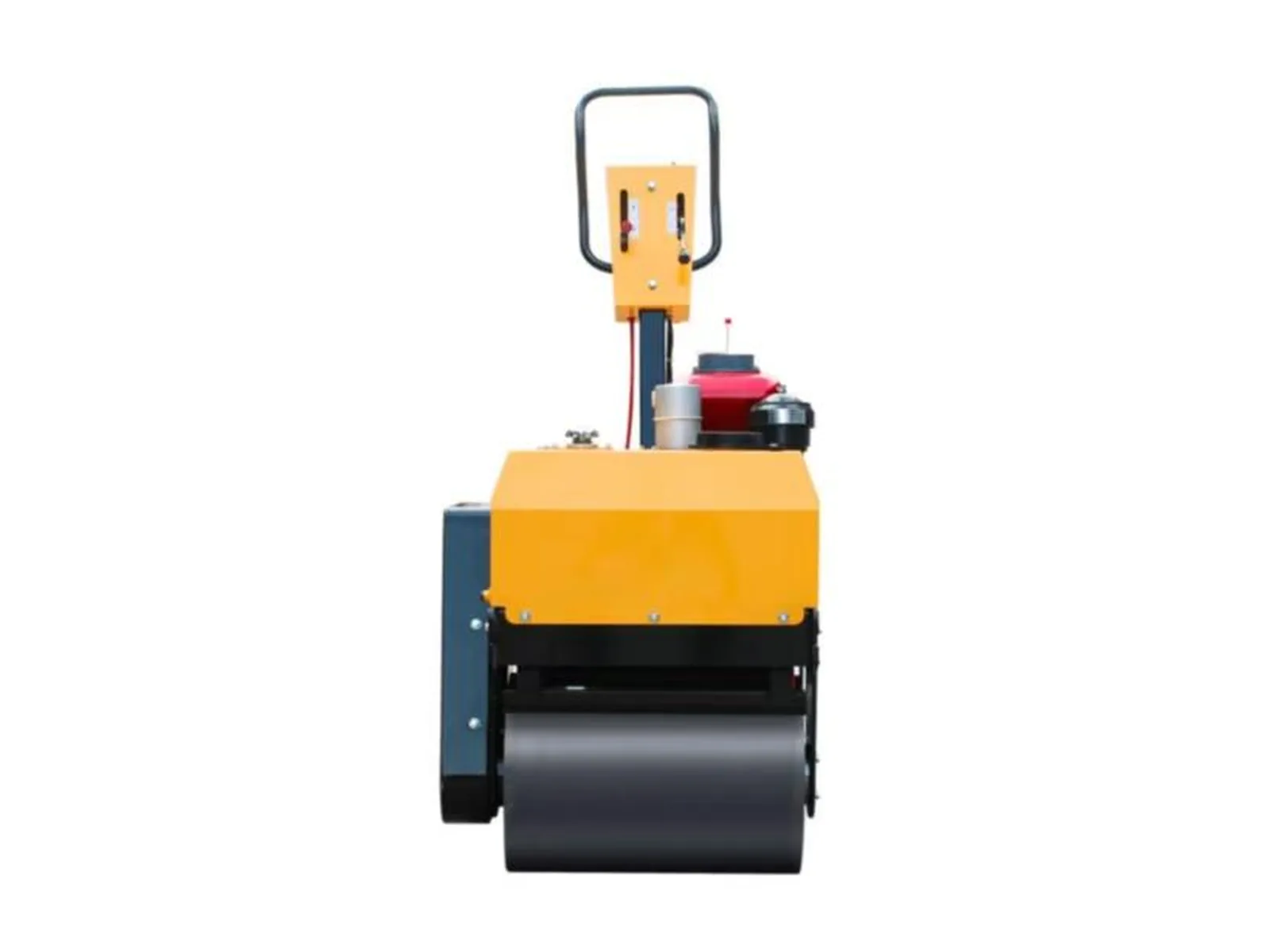
Walk-behind, 330 to 560 kg. The operator walks behind and steers by the handle. Both LC600 machines are 600 mm wide at the drum and under 800 mm wide overall, so they fit openings and trenches from 800 mm wide. The single drum unit measures 1,000 × 780 × 1,350 mm.
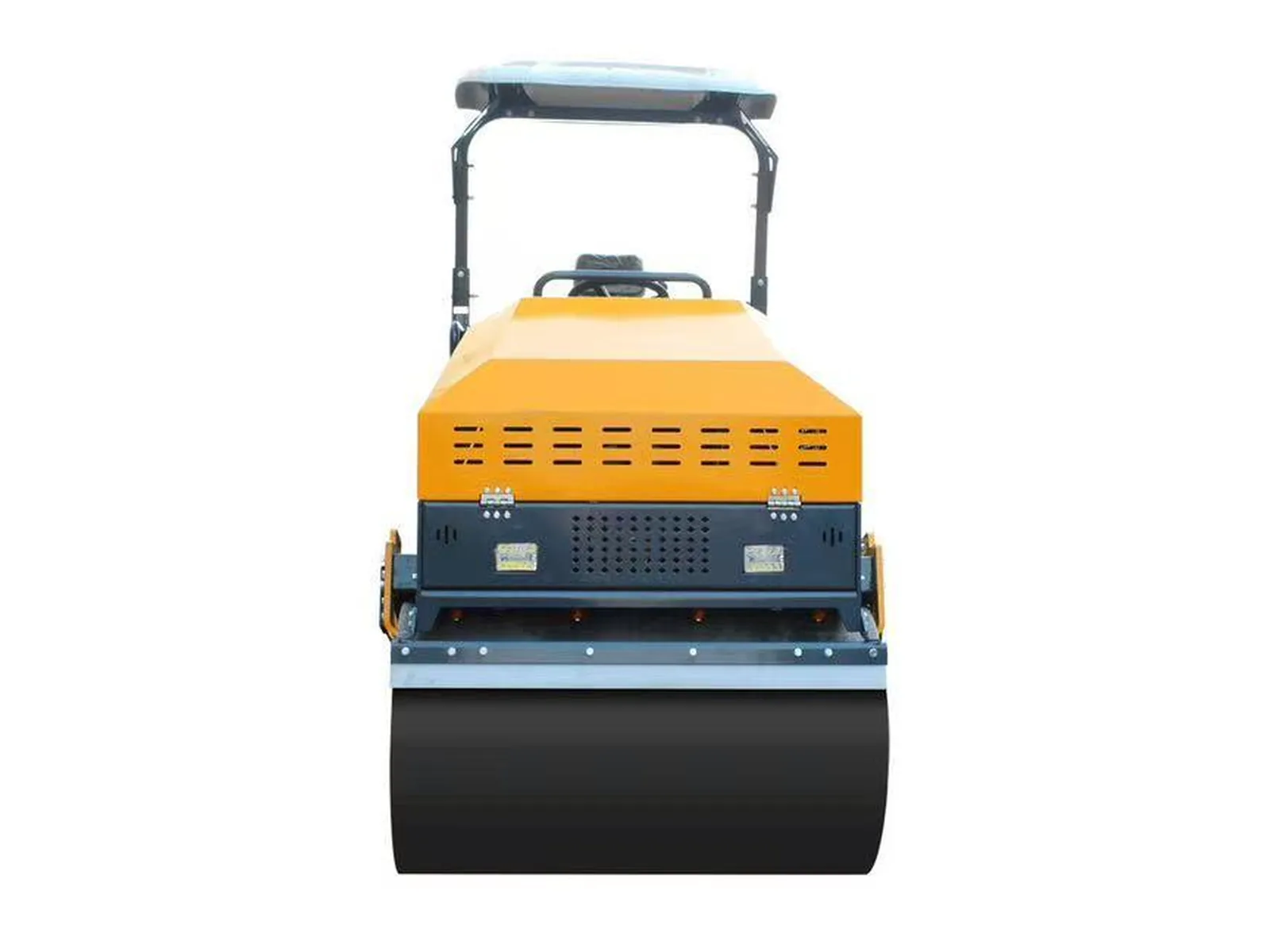
Ride-on, 800 to 1,200 kg. The LC700Z and LC800 carry a seat and a steering wheel. The LC700Z turns in a 1,800 mm radius, and its 700 mm front drum is wider than its 500 mm rear drum. The LC800 is 940 mm wide overall on 800 mm drums. This is the 1 ton class, the size usually meant by a small asphalt roller.
Fully hydraulic tandem, 1.5 to 3.3 t. From the LC900 upward the machines are fully hydraulic tandem rollers. Drum width rises in 100 mm steps from 900 to 1,200 mm. The LC900 and LC1000 climb a 35% grade, the steepest figure in this group. The LC203 adds front and rear scrapers, water-spray units and a 200 L water tank for municipal road maintenance, with ±26° steering.
How hard each one presses
The catalogue gives weight and vibration force. We turned them into two figures that can be compared across sizes. Static load is the machine’s weight in newtons divided by the total width of its drums in centimetres. The force ratio is the vibration force divided by the machine’s own weight.
| Model | Static load per cm of drum | Vibration force ÷ machine weight |
|---|---|---|
| LC600 single drum | 54 N/cm | 4.6 |
| LC600 tandem | 46 N/cm | 3.3 |
| LC700Z | 65 N/cm | 2.5 |
| LC800 | 74 N/cm | 2.1 |
| LC900 | 82 N/cm | 2.0 |
| LC1000 | 98 N/cm | 1.5 |
| LC1100 | 111 N/cm | 1.8 |
| LC1200 | 123 N/cm | 1.5 |
| LC203 | 136 N/cm (catalogue figure) | 1.9 |
Three things stand out.
- The lightest machines live on vibration. The 330 kg walk-behind hits with 4.6 times its own weight. By 2 t the ratio is about 1.5. A walk-behind mini road roller works because of its 70 Hz vibration, so run it with the vibration on.
- Two drums spread the weight. The 560 kg tandem presses 46 N/cm, less than the 54 N/cm of the 330 kg single drum unit, because its weight sits on 1,200 mm of drum, not 600 mm. What the second drum adds is a second pass on every run.
- Static load more than doubles across the range. From 54 N/cm at 330 kg to 136 N/cm at 3.3 t. The 8 t LCS208H single drum roller lists 230 N/cm, so a mini road roller suits thin layers and small areas.
Drum width and passes
Drum width decides how many side-by-side runs a strip needs. The counts below are the strip width divided by the drum width, rounded up, before any overlap.
| Drum width | Models | 1.2 m path or trench | 2.0 m driveway | 3.0 m lane |
|---|---|---|---|---|
| 600 mm | LC600 single drum, LC600 tandem | 2 | 4 | 5 |
| 800 mm | LC800 | 2 | 3 | 4 |
| 900 mm | LC900 | 2 | 3 | 4 |
| 1,000 mm | LC1000 | 2 | 2 | 3 |
| 1,100 mm | LC1100 | 2 | 2 | 3 |
| 1,200 mm | LC1200 | 1 | 2 | 3 |
| 1,250 mm | LC203 | 1 | 2 | 3 |
A 1,000 mm drum halves the runs of a 600 mm drum on a 2.0 m driveway. On a 3.0 m lane every model from the LC1000 up needs three runs, so beyond that point a larger model adds weight and speed, not fewer runs.
How to choose a mini road roller
- Measure the narrowest point. A trench or a gate under 1 m calls for a walk-behind LC600 or the 940 mm wide LC800.
- Match the strip width. Use the table above to see where a wider drum saves a run.
- Check the slope. Most models climb 30%. The LC900 and LC1000 climb 35%.
- Decide walk-behind or ride-on. For a full day of patching, a seat matters. Ride-on models start at 800 kg.
- Plan the move. The LC600 tandem weighs 560 kg and the LC1000 2,000 kg. Check your trailer or pickup rating against the operating weight in the first table.
New to compaction? Start with what is a road roller. Working on base layers or full road width? See the road roller types guide and the road roller weight chart for the 8 to 30 t machines. For surfacing work, the asphalt roller guide covers drum and water equipment.
Mini road roller questions
How much does a mini road roller weigh?
From 330 kg to 3,300 kg in the LICH range, or about 730 to 7,280 lb. The ride-on models start at 800 kg.
What is the smallest road roller?
The LC600 walk-behind single drum roller: 330 kg, one 600 mm drum and a 4 kW engine.
Which is the 1 ton asphalt roller?
The LC700Z at 800 kg and the LC800 at 1,200 kg sit either side of 1 t. Both are ride-on tandem rollers with 70 Hz vibration.
Can a mini road roller compact asphalt?
Yes. A tandem mini road roller with two smooth steel drums is the usual choice for patches, paths and driveways. The LC203 carries front and rear scrapers, water-spray units and a 200 L water tank.
How fast does a mini road roller travel?
Walk-behind models reach 4 km/h. Ride-on and hydraulic models reach 5 to 9 km/h, and the LC203 reaches 12 km/h.
Get a mini road roller matched to your job
Send us the material, the strip width, the narrowest access point and your destination port. We will suggest the model and send its specification sheet.
Related reading: which road roller manufacturers list walk-behind and compact rollers.