What is a road roller? It is a compaction machine that drives over soil, gravel or asphalt and presses the layer down with steel drums or rubber tyres until it is dense enough to carry traffic. Most models add vibration to the drum, which puts a dynamic force on top of the weight. LICH lists 24 road rollers, from a 330 kg walk-behind unit to a 30 t pneumatic tyre roller, and this guide uses their figures to show what the parts do, how a road roller compacts and which type works on which layer.
Every model is on the road roller page with its full specification.
What is a road roller made of?
Six parts do the work.
- Drum. A hollow steel cylinder that carries the weight onto the ground. On the 16 t LC216B it is 2,100 mm wide and 1,570 mm in diameter.
- Vibration system. An off-centre weight spins inside the drum and makes it strike the ground many times a second. Catalogue figures for it are frequency in Hz, amplitude in mm and centrifugal force in kN.
- Drive. A single drum roller is pushed by two rear tyres. A tandem roller drives both drums. Travel is mechanical with fixed gears on some models and hydraulic with stepless speed on others.
- Articulated frame. The machine bends in the middle to steer, which keeps the drum and the rear wheels on the same track.
- Scrapers and water spray. On asphalt, scrapers and a water film keep hot mix from sticking to the drums. The 14 t LC214 tandem roller carries two 600 L water tanks.
- Engine and cab. Power runs from 4 kW on the walk-behind LC600 to 140 kW on the 18 t LCS718H.
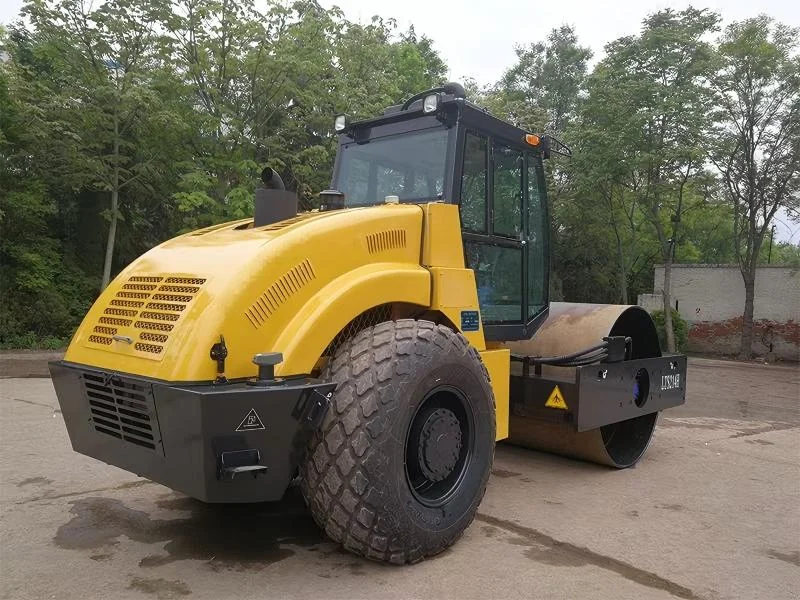
How a road roller compacts
A road roller uses up to three actions.
Static weight. The drum presses with its share of the machine’s weight. The figure to compare is static linear load, the force on each centimetre of drum width. It runs from 136 N/cm on the 3.3 t LC203 to 470 N/cm on the 18 t LCS718H. On the 12 t LCS212H, 286 N/cm across a 2,100 mm drum works out at about 6,100 kg on the drum, 51% of the machine.
Vibration. The spinning weight adds a dynamic force far above the static one: 260 kN on a 12 t roller and 390 kN on the 18 t model. Frequency is the number of blows per second. Small rollers run fast and shallow, 70 Hz on machines up to 3 t. The 12 to 18 t single drum rollers run slow and deep, 28 to 35 Hz with an amplitude of 1.6 to 1.9 mm.
Speed and frequency work together. We divided frequency by travel speed for the LC216B, which vibrates at 30 Hz and has three gears:
| Gear | Travel speed | Blows per metre of travel |
|---|---|---|
| First | 2.0 km/h | 54 |
| Second | 4.0 km/h | 27 |
| Third | 10.5 km/h | 10 |
Doubling the speed halves the blows each metre of ground receives. That is why the low gears are the working gears and the top gear is for moving between sections.
Kneading. A pneumatic tyre roller has no vibration. Its rubber tyres flex and work the material from the sides as well as from above, and the rear row covers the gaps left by the front row. The LCP1016H runs four tyres in front and five behind across 2,280 mm.
Types and sizes
| Type | What touches the ground | LICH models | Operating weight |
|---|---|---|---|
| Single drum roller | One steel drum, two drive tyres | 12 | 330 kg to 18 t |
| Tandem roller | Two steel drums | 10 | 560 kg to 14 t |
| Pneumatic tyre roller | 9 or 11 rubber tyres | 2 | 10 to 30 t with ballast |
Source: LICH product catalogue, read on 13 November 2026.
The heaviest machine in the range weighs about 90 times the lightest. Travel speed changes far less: 4 km/h for a walk-behind unit and 10 to 14 km/h for the large machines. For each type in detail, read road roller types. For every model by weight, see the road roller weight chart. The small end is covered in the mini road roller guide.
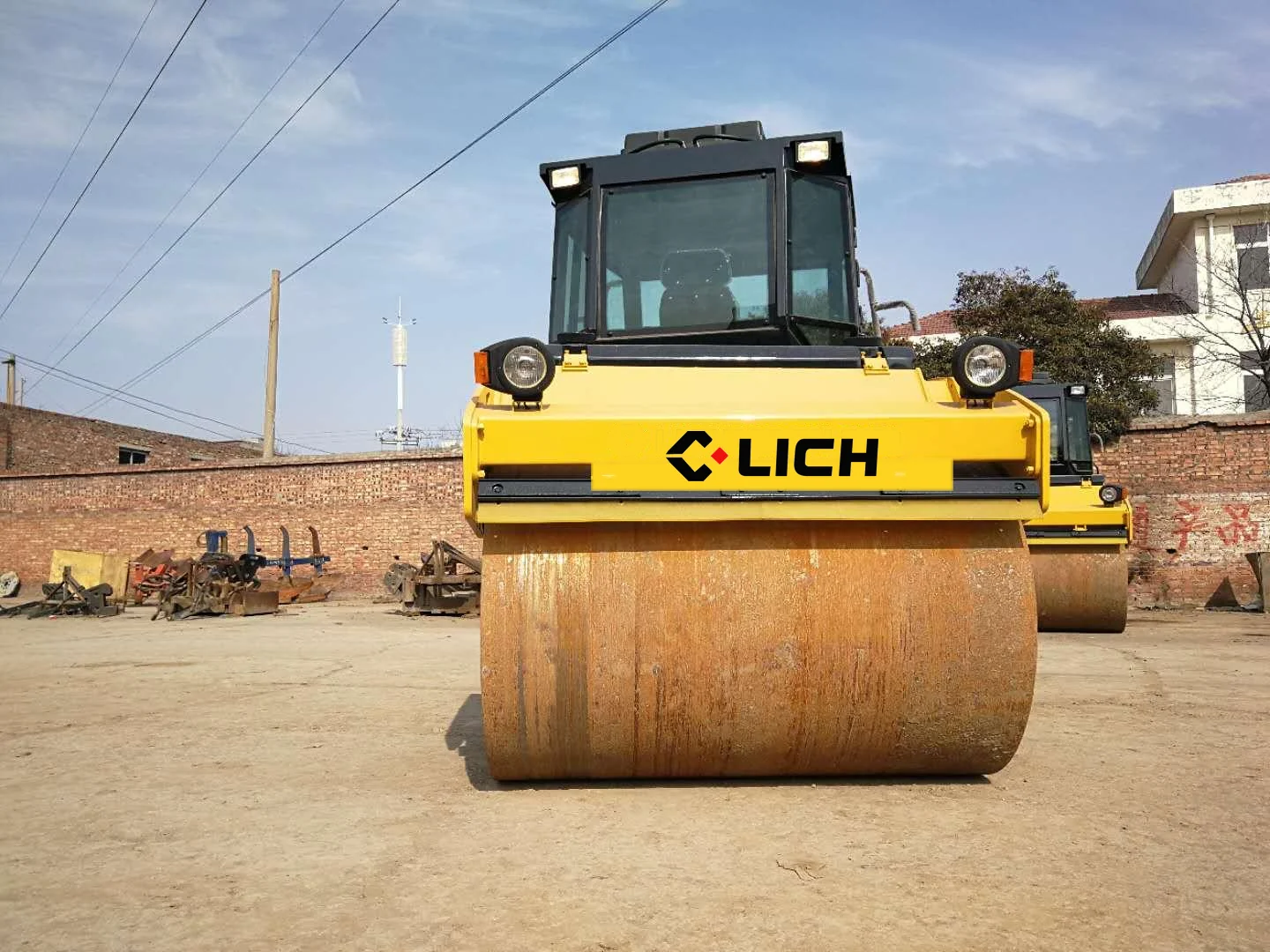
Which roller for which layer
| Material or job | Roller type | Example |
|---|---|---|
| Sandy soil, gravel, crushed stone, rock fill | Single drum vibratory roller | LCS212H, 260 / 160 kN |
| Asphalt courses, roller-compacted concrete | Tandem roller | LC214, 40 / 46 Hz |
| Asphalt concrete, stabilized soil | Pneumatic tyre roller | LCP1016H, 10 to 16 t |
| Municipal repairs, trench and pipeline backfill | Compact tandem or walk-behind roller | LC203, 3.3 t |
On a new road these machines follow one another. A single drum road roller compacts the earthworks and the base. A tandem roller follows the paver on the asphalt, and a pneumatic tyre roller kneads the surface course. The single drum vs double drum roller comparison shows the two steel drum types at the same 14 t weight, and the amplitude and frequency guide explains the vibration settings.
Road roller questions
What is a road roller used for?
Compacting soil, gravel, crushed stone and asphalt for roads, airports, dams, yards and building foundations.
What is a road roller also called?
A roller compactor, a compaction roller or simply a roller. Steamroller is the old name from the days of steam power.
How heavy is a road roller?
From 330 kg to 30 t in the LICH range. Single drum rollers for earthworks weigh 8 to 18 t.
How fast does a road roller go?
Between 4 and 14 km/h at top speed. Compaction is done in the low gears, 2.0 to 4.0 km/h on the LC216B.
Is a road roller the same as a compactor?
A road roller is one kind of compactor. It compacts while rolling on drums or tyres. Plate compactors and rammers are the hand-guided kinds for very small areas.
Find the road roller for your project
Send us the material, the layer thickness, the area and your destination port. We will suggest the type and weight and send the specification sheet.
Related reading: road roller manufacturers compared by roller types and published weight ranges.